|
Spectacular new images of Mars could reveal clues about tens of millions of years of the red planet's history.
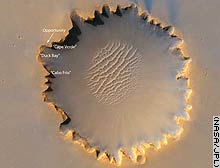
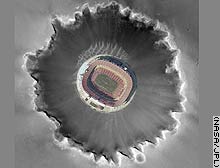
NASA has just released photos taken from above the planet by the spacecraft Mars Reconnaissance Orbiter, showing the rover Opportunity perched next to the enormous Victoria Crater. Four or five football stadiums could fit inside the crater.
"We've taken approximately 160,000 photographs from Spirit and Opportunity," said Jim Bell, lead scientist for the rover's panoramic camera. "The images that have come down just this week have instantly vaulted to my top 10 list," he said.
|
|
 |
 |
|
NASA's MRO took this photo of Victoria Crater's distinctive scalloped shaped rim.
|
Opportunity sent this photo, later color enhanced, of the rim of Victoria Crater.
|
Scientists say the crater is big enough to hold four or five football stadiums.
|
The rovers Spirt and Opportunity landed on Mars three weeks apart in January 2004.
The images were taken from about 170 miles above the Martian surface, revealing information about the sedimentary layering of the planet.
"We can see the shadows, cast by the cliffs that are up to several hundred feet high," said Alfred McEwen, principal investigator of the Mars Reconnaissance Orbiter's HiRISE camera.
"If you look on the crater floor, you can see some boulders; those are typically three to six to nine feet in diameter, the largest ones being comparable in size to the rover. This crater has a distinctive shape to it -- with all of the bays and alcoves -- that's related to the original shape of the crater, but accentuated by erosion, and wind erosion," he said.
Few scientists imagined the two robots would still be gathering information. The robots, about the size of motorized golf carts, have continued to function, 10 times longer than expected.
"Today is day 960 of Opportunity's 90-day mission to Mars," said Steve Squyres from Cornell University.
The rover team's next task is to decide how to get the best scientific information out of what is already borrowed time. Scientists would love to get a closer look inside the crater, but planning that kind of navigation is difficult.
But though careful planning is needed to make sure Opportunity doesn't get stuck, the options are being considered at a brisk pace.
"Whether we're going to go a third of the way around, a quarter, halfway around, I don't know," Squyres said. "But as soon as we have located a safe place to go in, a probable safe place to come out, we're going to go in this crater for sure," he said.
"The thing we've always got to keep in mind is these vehicles are 10 times past their warranty. This vehicle could die at any moment. We have no guarantee it's going to last. We are going have to use this thing aggressively. We are not going to do a leisurely tour along the rim of this crater because our days are numbered," said Squyres.
Scientists chose to send Opportunity to the Victoria site because of the crater's varying geology.
Images of Victoria captured by the Mars Global Surveyor, which has been orbiting the planet since 1997, showed the half-mile-wide crater had alternating high ledges and gentler alcoves. It's a good place to see "bigger slices of Martian time," Squyres said.
In addition to deciding when and where to enter the crater, the researchers will have to decide whether to go clockwise or counterclockwise, depending on factors like how Opportunity's solar arrays can get power from the sun.
"You really have to respect this landscape. It is a potentially very, very dangerous place for the rover, and we have 'goo-goo' eyes about the potential of what we can do, but we have to be extremely, extremely cautious," Bell said.
The scientists shared their amazement at a news conference at NASA headquarters in Washington.
"That image, with that little rover 200 million miles away, parked at the top of that cliff, that's just one of the most evocative images I've ever seen," Squyres said.
"For me, this week has felt like opening a book, maybe a mystery novel, and you read the first few lines, the first few pages. And you're hooked, you're absolutely hooked on it. We have just opened the book with Opportunity showing up at Victoria," said Bell.
The other rover, Spirit, is working on the opposite side of the planet from Opportunity. Both are outfitted with the basic toolkit of a field geologist, gathering information on rock formations, soil and atmosphere.
So far Opportunity has logged about six miles and Spirit, 3.7 miles. The rovers can move about 44 yards per day.
By Marsha Walton - CNN |